
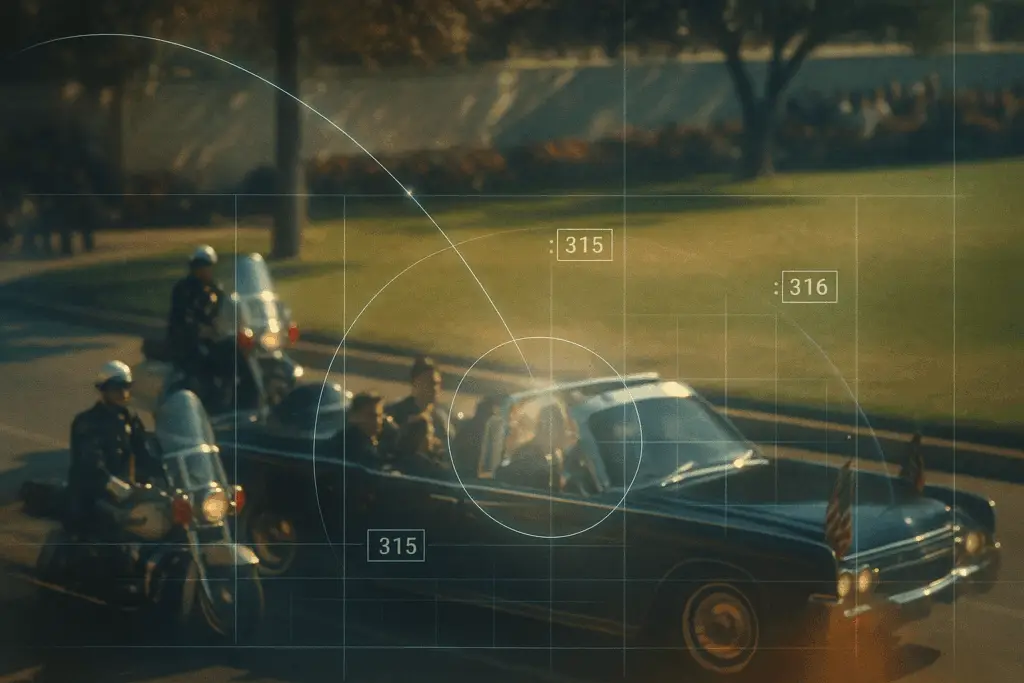
Can Artificial Intelligence (AI) solve one of the world’s greatest murders?
Most of us have fallen into the rabbit hole of short videos on our phones. It usually starts with a quick clip from some documentary, then another one pops up, then another, and before long twenty minutes (…or two hours) have disappeared.
Every now and then, one of those clips pulls you into a moment that shaped the entire country. A shaky recording. A grainy picture. A video that changed the world before most of us were born.
It makes you think. We have the most advanced technology humanity has ever created sitting in our pockets, yet some of the most important evidence in American history was captured on cameras that would struggle to compete with a child’s toy today.
That is why I started wondering what would happen if we took the same iconic footage from decades ago and looked at it through the lens of modern artificial intelligence (AI). Not for entertainment. Not for speculation. But for clarity. For truth. For the same reason I approach every piece of digital evidence in my forensic work.
So let’s take the most famous piece of civilian video in history, the Zapruder film, and let’s walk through what AI could do with it today, what kinds of insights might emerge, and how a modern forensic examiner approaches historical footage with today’s technology.
We live in a moment where technology evolves at an unbelievable pace. Cameras do things on their own that trained professionals used to spend days perfecting. A phone can stabilize video better than full production studios in the 80s. Filters do things that used to take expensive equipment.
But one thing hasn’t changed, the recordings themselves.
A piece of footage captured in 1963 is still the same piece of footage. The camera did what it did. The film roll captured what it captured. And for years, people examined that material using whatever tools they had at the time. Some tools were impressive. Most were limited.
Now we have AI models that can analyze motion patterns, rebuild frames that were damaged, reduce noise without destroying detail, and track objects from one frame to another with mathematical precision. For the first time, we can revisit old recordings with new eyes.
Not to revise history. Not to chase conspiracy theories. But to understand the evidence itself with a level of clarity that simply did not exist before now.
As someone who works with digital evidence in the present day, I understand how delicate this balance is. The goal is never to mold the evidence into a story. The goal is to let the evidence speak by removing the obstacles that hide its details.
AI gives us that opportunity when used correctly and responsibly.
On November 22, 1963, Abraham Zapruder stood on a concrete pedestal with a home-movie camera and filmed the moment President John F. Kennedy was shot in Dallas, Texas. That 26-second, 8mm silent film became one of the most analyzed recordings in American history.
It has been studied frame by frame for decades. But the footage presents several challenges.
AI does not magically rewrite history. It cannot create information that never existed. But it can take the existing raw footage and help us see its details more clearly.
Here are some mid-level technical capabilities explained in simple terms.
AI can take low resolution footage and upscale it by studying patterns within the frames. This is not the old method of “blowing up a picture.” This is actual detail enhancement through learned patterns.
On the Zapruder film, this could:
Old film cameras often captured at lower frame rates. AI can smoothly recreate the in-between moments by analyzing object movement.
For the Zapruder film, this could do a few things:
AI can stabilize the camera shake without distorting the underlying movement.
Benefits of this are:
Film grain is part of the original artifact, but too much grain hides details. AI can remove noise while protecting edges and important structures.
This might accomplish a couple things:
AI can restore faded colors and bring consistency across frames. This is not cosmetic. Correct color helps analysts distinguish shadows, blood patterns, clothing differences, and reflective surfaces.
This is where AI really shines. Optical flow tracks movement through each pixel, mapping how objects shift from one frame to the next.
Applied to the Zapruder film, you might be able to:
AI can highlight:
This does not mean tampering. It simply flags areas worth a trained examiner’s attention.
Let’s be clear. AI cannot change what happened. It cannot answer every question about the shooting. But it can give us fresh insight by stripping away technical limitations.
Here is what we might learn using modern tools.
Stabilization and super resolution would produce a steadier, sharper view of:
This alone helps analysts reexamine timing and behavior.
Some of the most important frames suffer from motion blur. AI can reduce this blur, allowing clearer interpretation of:
Witnesses along the roadside reacted in different ways. AI could reveal more detail about:
These reactions are part of the historical context.
Optical flow can calculate exact movement patterns which might help confirm or refine timing analyses that were previously limited by frame quality.
Some areas of the film appear distorted or stretched because of things like film warping, chemical aging, frame tearing, and lens distortion.
AI can isolate what is an artifact versus what is part of the real scene.
This protects the integrity of the analysis and removes decades of misinterpretation caused by physical deterioration.
There are plenty of theories about possible missing frames of the Zapruder film. AI can rebuild damaged portions based on surrounding frames, similar to how forensic labs restore torn photographs. This does not create new evidence. It simply helps fill in gaps that degraded over time.
This is where I bring it into my world.
When I examine modern video evidence, I have to be careful. Technology can make things clearer, but it can also create traps if used without discipline. Check this out to see what poor performance can turn into.
Anyone who has researched the JFK Assassination knows just how quickly it can pull you down a thousand different rabbit holes.
And this… ladies and gentlemen is why this project isn’t quite complete… yet!
Modern forensic examination of the Zapruder film will take an enormous amount of time and effort to complete. But I will say I consider it to be my next big undertaking.
As I begin my analysis, here are the principles I follow.
No enhancement replaces the source material. AI is a lens, not a replacement.
If a tool cannot reproduce the same results consistently, it cannot be trusted in forensic work.
AI helps reveal patterns. It does not interpret meaning. A human with training has to guide the analysis and understand the context.
As a forensic examiner, I do not walk into an investigation with a story in my head. The evidence tells the story. My job is to make sure nothing interferes with that.
The Zapruder film is not just evidence. It is a cultural artifact. If AI is used, it has to be used transparently, with an explanation of every step.
These principles protect the truth from over-interpretation or misuse.
AI brings incredible power to historical analysis. It can sharpen the past, stabilize shaky frames, highlight details we missed, and help us view a moment with a clarity that was impossible sixty years ago.
But with great power comes great… temptation.
It becomes easy to treat AI output as if it is definitive. It becomes easy to believe that a sharper image means a clearer answer. It becomes easy to overlook the fact that AI is a reconstruction tool, not a time machine.
This is the trap. If people begin treating AI output as gospel, we will distort the very history we are trying to understand.
The right way to use AI is simple. Use it to remove technical barriers. Use it to highlight patterns that deserve human review. Use it to open the door to better questions. But never let it become the final word without human judgment.
Re-analyzing the Zapruder film with AI is not about rewriting history. It is about honoring history with the best tools we have.
Here are a few possibilities for the future:
We owe it to history to use the best tools available.
History does not change. Our tools do.
When we revisit a piece of footage like the iconic Zapruder film using modern AI, we are not rewriting the past. We are simply clearing the dust from the window so we can see a little more clearly.
And maybe that is the lesson for today. The truth does not need to be reinvented. It just needs to be revealed. AI gives us the ability to do that when used with discipline, objectivity, and respect for what came before us.
I plan to complete the full forensic review and analysis of the entire Zapruder film by mid 2026 and report those findings to the public. Even if nothing new is revealed, at least that, in and of itself, will be an answer to some looming questions of authenticity and/or manipulation.
If you want to learn about other ways that AI helps to solve criminal cases, check out this article from Medium.